STUDIO FIELDNOTES / LESSON 14
Water Lines
Can a line suggest fast or quiet movement?
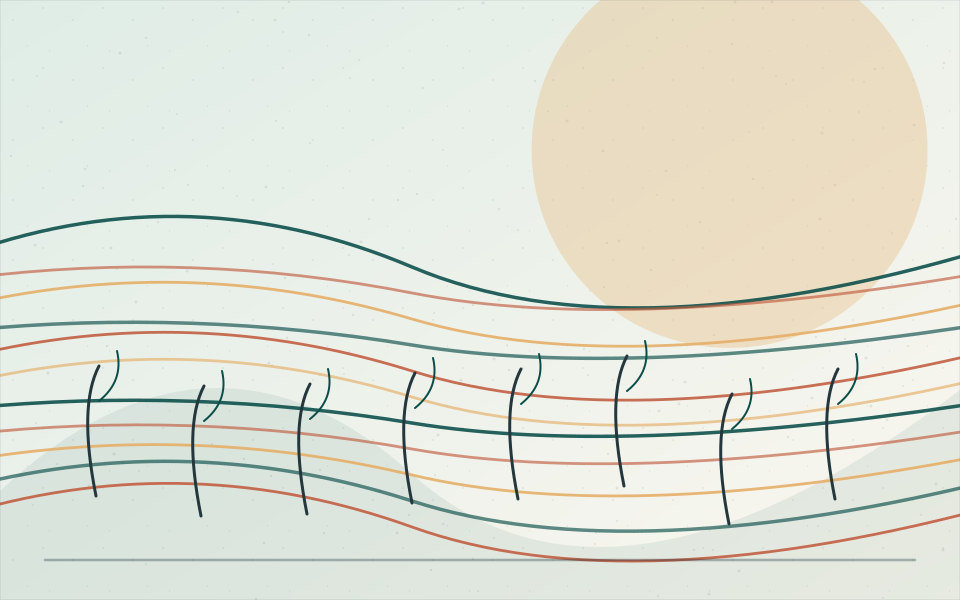
The artistic investigation
Observe, choose, make, revise.
Draw two kinds of moving water and invent a safe imaginary river scene.
Learning targets
- Investigate the question: Can a line suggest fast or quiet movement?
- Apply line weight, direction, repetition, blue-green mixtures in a deliberate original composition.
- Use critique evidence to improve line weight and name one next step.
What success looks like
- The final artwork solves this problem: Draw two kinds of moving water and invent a safe imaginary river scene.
- Artwork includes three differentiated lines that suggest different water movements.
- Process evidence shows two different options before selection.
- Visual decisions demonstrate line weight and support the intended audience.
- Feedback results in at least one visible revision that the student can explain.
Louisiana cultural context
Compare the Mississippi River, local canals, ponds, and rain patterns with age-appropriate images.
Student choice and access: Students may work from imagined water, access needs, or land-based analogies.
Technique to teach
line weight, direction, repetition, blue-green mixtures
Standards & studio habits
Louisiana K–4 cluster: VA-CE-E1, VA-CE-E3, VA-CE-E5, VA-AP-E6
Studio Habits of Mind: Observe, Envision, Express, Reflect
The investigation sequence
Ten actions, one artistic problem.
Engage
Present the artistic question: Can a line suggest fast or quiet movement? Give students two contrasting examples that do not dictate a finished product.
Investigate
Compare the Mississippi River, local canals, ponds, and rain patterns with age-appropriate images. Gather visual evidence and note what is observed rather than assumed.
Skill Studio
Demonstrate line weight, direction, repetition, blue-green mixtures. Make thinking visible by testing two alternate solutions and identifying what each communicates.
Generate
Develop two possibilities for the challenge: Draw two kinds of moving water and invent a safe imaginary river scene. Change the focal point, material, arrangement or viewer perspective between drafts.
Plan
Compare sketches to the success check (three differentiated lines that suggest different water movements); choose a direction and state why it better communicates the intention.
Produce
Produce an original visual response using line weight, direction, repetition, blue-green mixtures; conference on one technical choice and one contextual question.
Critique
Partners identify where the artwork communicates the intended idea and locate evidence of line weight in the work.
Revise
Revisit the specific checkpoint: Three differentiated lines that suggest different water movements. Make one visible change after critique and preserve the initial view for comparison.
Present
Present with a title, medium, one key artistic decision and any needed credit or contextual limitation.
Reflect
Reflect: What evidence proves you improved line weight? What will you try or investigate next?
Evidence of student learning
Assess decisions, not sameness.
Diagnostic
Observation notes related to: Compare the Mississippi River, local canals, ponds, and rain patterns with age-appropriate images.
Formative
Visible practice with line weight, direction, repetition, blue-green mixtures.
Revision evidence
Critique evidence and one documented, purposeful revision.
Respect the culture and context
Discuss water observation safely; no unsupervised waterfront collection.
Bring this into your studio.
Teach the artistic problem, leave room for student voice, and document visible growth.